
Bed bugs: what they look like at every stage, bed bug bites, and how to get rid of them
How to identify bed bugs as eggs, nymphs and adults, what proves a bite came from one, and why home spraying fails at the cracks that hold the eggs.
Bed bugs are easy to recognize once you know what to look for. An adult is reddish brown, flat and wingless, 5 to 7 mm long, about the size of an apple seed. The young are paler and almost see-through, and the egg is pearly white and 1 mm long. Bed bugs bite people at night, and getting rid of them means reaching the cracks where they hide with their eggs.
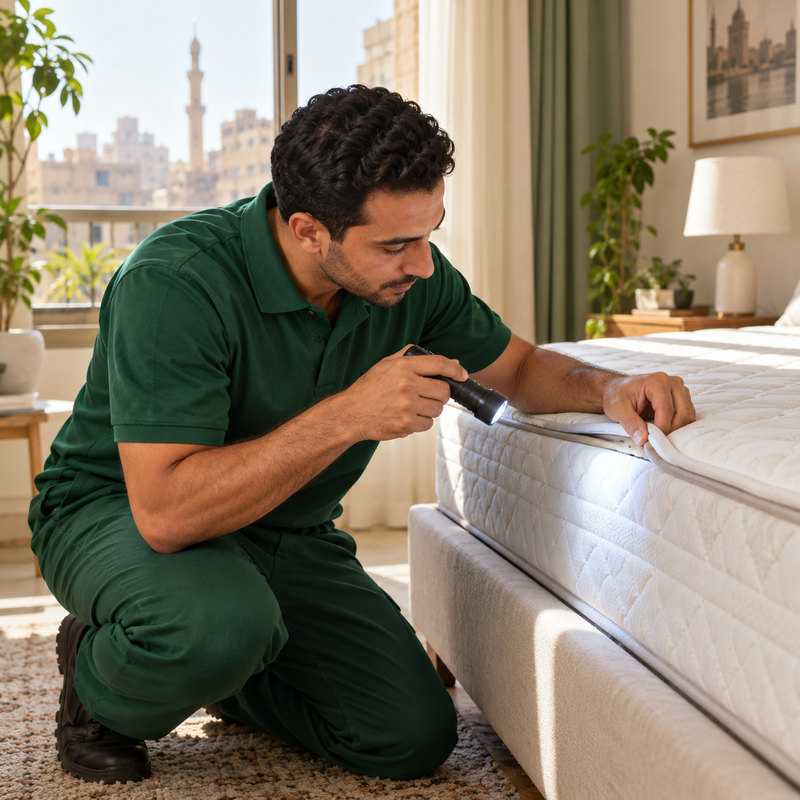
Before anyone says a word about spraying, we lift the sheet and run a flashlight along the mattress seam. This guide to bed bugs in Egypt shows what we look for, with references from the CDC, the US Environmental Protection Agency (EPA) and university entomology departments. For the treatment itself, see our bed bug control page.
What do bed bugs look like at each stage?
Bed bugs go through three forms: egg, nymph (five growth stages) and adult. A nymph sheds its skin between stages, leaving 5 shells behind. Search for what bed bugs look like and you’ll mostly get photos of a fat adult, but the younger stages are the ones that fool people into saying the mattress is clean.
The egg: too small to notice
An egg is the size of a pinhead, about 1 mm, and pearly white. After 5 days it develops a spot that looks like an eye. A sticky coating glues it to wood and fabric, so shaking out the sheet or wiping the bed rarely dislodges it.
A female usually lays 1 to 5 eggs a day, and 200 to 500 in her lifetime. At room temperature an egg hatches in roughly one to two weeks. On a wooden bed we look for eggs at the slat joints and in nail holes.
The nymph: “baby” and “white” bed bugs
A nymph is a young bed bug: smaller and paler than its mother, translucent or yellowish white, and barely visible before feeding. So when someone Googles “white bed bugs” or “tiny bed bugs,” they’re usually describing a nymph that hatched days ago, or an empty shell left by a bigger one.
A nymph needs at least one blood meal before each new stage, growing from 1.5 mm to 4.5 mm. If one crack holds bugs of different sizes, a new generation is already growing in your home, and the problem started before the first bite you noticed.
The adult: the big bed bug
An adult is 5 to 7 mm long. The University of Kentucky says it’s the color of an apple seed but closer in size to a lentil, a handy comparison in any Egyptian kitchen. The body is oval, with 6 legs and no wings.
Feeding changes its shape. Before a meal it’s brown and flat as paper. After one it swells like a balloon, turns reddish brown and gets longer. A meal takes 3 to 10 minutes, the bug can swallow up to 6 times its weight in blood, and adults feed roughly every 5 to 7 days.
| Stage | Approx. length | Appearance | What to know |
|---|---|---|---|
| Egg | 1 mm | Pearly white, sticky | Eye-like spot after 5 days |
| First nymph | 1.5 mm | Translucent, straw colored | Hardest to see before its first meal |
| Second nymph | 2 mm | Translucent or yellowish white | Needs a blood meal before each molt |
| Third nymph | 2.5 mm | Translucent or yellowish white | Much easier to see after feeding |
| Fourth nymph | 3 mm | Slightly darker after feeding | Leaves a pale shell when it molts |
| Fifth nymph | 4.5 mm | Close to the adult’s shape | Last stage before adulthood |
| Adult | 5 to 7 mm | Reddish brown, flat before feeding | Females lay eggs; feeds every 5 to 7 days |
- EggAbout 1 mm, pearly
- Small nymphAbout 1.5 mm, translucent and yellowish
- Medium nymphAbout 3 mm, darkens after feeding
- Large nymphAbout 4.5 mm
- Adult5 to 7 mm, reddish brown
How long from egg to adult?
Development from egg to adult takes 5 weeks to 4 months, depending on temperature and food, and is fastest between 21 and 28°C, close to what many Egyptian apartments sit at most of the year. The EPA says the full cycle, egg to egg, can finish in 4 to 5 weeks under suitable conditions.
An adult lives about 10 months on average and can pass a year, with up to 4 generations a year. Worse, it can go hungry for 1 to 4 months in moderately heated buildings, and for a year or more at 13°C or below.
“Wood bugs”: a different species?
No. When people in Egypt search for “wood bugs” (baq el-khashab), they usually mean ordinary bed bugs living in the cracks of a wooden bed or nightstand. Bed bugs prefer wood and fabric to metal and plastic, so old wooden bedroom sets with many joints suit them well. Small holes in the wood with fine sawdust are a different problem, covered in our article on termites vs. woodworm.
Bugs that look like bed bugs, and how to tell them apart
The US EPA warns that misidentifying the insect lets an infestation spread. These are the most common mix-ups:
- Carpet beetle: The larva is very hairy and not flat. It doesn’t bite, but its hairs can irritate skin and leave a bite-like mark.
- German cockroach nymph: On the job we see it around kitchen and bathroom sinks far more than in mattress seams.
- Tick: It has 8 legs against the bed bug’s 6. Count them on a zoomed-in photo.
- Book louse: Soft, light brown body with a protruding face, unlike a bed bug’s flat oval.
- Flea: Up to about 3 mm, with a body flattened side to side. It jumps when you get close and usually goes with a cat or dog.
- Bat and bird bugs: Only the hairs under a magnifying lens separate them from bed bugs. If a pigeon or bird nest sits against the bedroom window, tell the technician, because the work then starts at the nest.
Before you decide, lift the insect with clear tape onto white paper and send us a clear photo on WhatsApp. Texas A&M recommends collecting a sample and using no insecticide until the insect is identified.
Do bed bugs fly or jump?
Bed bugs neither fly nor jump. They have no wings, and the University of Kentucky confirms they don’t jump like fleas, though they crawl quickly across floors, walls and ceilings. If the insect flew off or jumped, think fleas or something else.
They spread anyway. The CDC says they can crawl more than 30 meters in a night, though they usually stay within 2.4 meters of where someone sleeps. The University of California puts about 85% of bed bugs in or next to the bed, and the other 15% in upholstered furniture, closets and under wallpaper. So our inspection starts at the bed and widens in circles.
What do bed bug bites look like?
You usually won’t feel a bed bug bite. Their saliva contains an anesthetic and an anticoagulant, so the meal ends while you sleep. Bites tend to appear in the morning on skin exposed during sleep, like the face, neck, shoulders, arms and legs, as itchy red spots in a cluster or a line.
Seattle Children’s Hospital describes a red bump, sometimes with a red dot at the center or a small blister, usually 12 mm or smaller. More than 3 bumps in a row on exposed skin should make you suspect bed bugs. Timing varies: the CDC says the mark appears after a day to several days, and in some people up to 14 days later.
Some people don’t react at all. Studies cited by the University of Kentucky found about 30% of people in infested apartments show no reaction even with repeated bites, and the share is higher among older people. So one spouse wakes up with fresh bites while the other insists nothing touched them. Redness fades in about 3 days and swelling in about 7, but the itch can last two weeks.
A hungry bed bug will come out by day if a person is still and close by. The University of Kentucky notes they adjust to a person’s sleep schedule, so someone on night shifts who sleeps through the morning gets bitten too.
Bed bug, flea or mosquito bite?
Use this table to narrow down the cause, then check the place itself.
| Compare | Bed bug | Flea | Mosquito |
|---|---|---|---|
| Where it bites | Any skin exposed during sleep | Usually legs and ankles | Exposed skin |
| Usual look | Red bumps in a cluster or line | Small red dot with a halo | Raised, flat patch |
| Clearest timing | At night; mark shows in the morning or up to 14 days later | When walking where fleas live | Evening and morning |
| Do you see the insect? | Rarely, it hides by day | Often, it jumps | Often, it flies |
| Helpful clue | Black specks and shells on the mattress | A pet or rodents nearby | Standing water or an open window |
Skin alone can’t settle it. The University of Kentucky says diagnosing bites is hard even for doctors, and the EPA notes that bed bug bites can resemble eczema, fungal infections or hives. The evidence we accept is the insect itself, its shed skins, or black specks on the mattress.
Bed bug bites on children
On children, bed bug bites usually appear on the arms, legs and face. This is general information and can’t diagnose your child, so let the pediatrician decide on any cream or allergy medicine and its dose. At home, keep the child’s nails short and limit scratching, since that’s how infection gets in.
Repellents applied to the skin won’t help, Seattle Children’s says, including the well-known mosquito products. In a child’s room, start with the mattress seam and the bed, then the fabric toys nearby.
When should you see a doctor?
Most bed bug bites need only itch relief and clean skin, according to the CDC. In October 2023, Egypt’s Ministry of Health advised against scratching and recommended soothing ointments, antiseptics and antihistamines after consulting a doctor. These cases need a doctor, following Seattle Children’s Hospital guidance:
- Emergency, right away: Sudden trouble breathing or swallowing, even after a bite that looked minor. This severe allergy is rare, but you can’t wait on it.
- Doctor the same day: Redness or a red streak spreading with a fever, a large red area that keeps growing, or a child who seems very tired.
- Doctor within 24 hours: Painful redness that appears more than a day after the bite, or redness still spreading after 48 hours.
- Regular appointment: A bite that hasn’t improved after 7 days or hasn’t gone after 14, or a scab that looks infected.
The CDC and Egypt’s Ministry of Health both say bed bugs aren’t known to transmit disease. Skin damage usually comes from scratching that turns into a secondary infection.
The EPA mentions anxiety and insomnia among people in infested homes, and the University of Kentucky adds embarrassment. If the insomnia drags on, tell the doctor as you would about the bite. And if inspection and traps turn up no trace of the insect, the University of Kentucky recommends a dermatologist, since dry skin, some medications and household products can also cause itching.
Signs of bed bugs on mattresses and wood, and how to inspect
Bites are a weak indicator. These are the signs we rely on:
- Black or brown specks: These are droppings, and they look like felt-tip marker dots on fabric. A damp tissue usually smears them brown.
- Rusty spots on the sheet: A fed bug got crushed as you rolled over.
- Pale, empty shells: The strongest evidence of recent activity, since each shell means a nymph has grown.
- White eggs in cracks, or empty eggshells next to them.
- A sweet, slightly moldy smell that we compare on the job to coriander. The University of Kentucky cautions that it rarely appears except in heavy infestations, so don’t rely on it.
How to inspect your home yourself
Pick a time in daylight and bring your phone flashlight, a small mirror, and a magnifying glass if you have one. Then go in this order:
- Strip the sheet and pillowcases, checking every fold before bagging them.
- Run the flashlight along the mattress seam on both sides, then the edges, the side band and the tag.
- Lift the mattress and check the slats where they rest on the frame, and the nail holes.
- Check the back of the headboard, especially if it’s fixed to the wall.
- Empty the nightstand drawers and turn it over, because drawer joints suit bed bugs well.
- Move to the living room set: seat and armrest seams, between the cushions, and under the wooden frame.
- If the infestation is obvious, widen the circle to curtain folds, behind picture frames and around power outlets.
Any crack a credit card fits into can hide an adult, and NC State University says a bed bug can hide in a crack as thin as a sheet of paper. The same university mentions a simple trick: blow gently into the crack, and the bugs may move and show themselves.
Trap bed bugs with two plastic containers
If you’ve found nothing and the bites keep coming, put a trap under each bed leg. The University of California says these traps caught about 6 times what visual inspection found. The EPA’s homemade version is a clean plastic container inside a larger one, tape on the outside of the larger one so bugs can climb it, and a little talcum powder in both bottoms. Move the bed a few centimeters from the wall, keep the sheet off the floor, and check the traps every week.
Where else do bed bugs hide?
Bed bugs don’t build nests like ants, but they keep returning to the same hiding spots, and a flat body gets them into cracks no wider than a toothpick. The older the infestation, the farther they get from the bed.
In Egyptian homes we also check inside wooden wardrobes, under-bed storage, the carpet edge behind the bed and sofa, the baseboard, behind frames and mirrors, and under bubbled wallpaper. The University of Kentucky adds book spines and the insides of clocks, phones and TVs. A sofa someone sleeps on works exactly like a bed, so we check it just as closely.
Why do bed bugs show up in clean homes?
Blood is all bed bugs eat, so dirt and crumbs mean nothing to them. The University of Kentucky says very clean homes are as vulnerable as any others, and the CDC notes they have turned up even in five-star hotels. Many of the homes we inspect are tidy, so there’s no reason to feel embarrassed when you call. The most common causes are:
- Suitcases: Most of our summer cases started with a suitcase back from a hotel or furnished rental on the North Coast, in Gamasa or in Ras El Bar, where bed bugs get into seams and folded clothes.
- Used furniture: A secondhand bed, a sofa from Cairo’s Friday market (Souq al-Gomaa), or a living room set from an online sale group that nobody checked.
- Guests and visits: Visiting an infested home, or hosting someone who came from one, is enough. NC State says an infestation usually begins with a hitchhiker.
- Public transport: The CDC lists trains and buses among the places bed bugs may be found.
- Neighbors: In older buildings, bed bugs move between rooms and floors through gaps in walls and floors, especially around pipes.
The worst decision after finding them is locking up the apartment for two weeks in the hope they’ll starve. The University of Kentucky calls this impractical, and says bed bugs in empty apartments often move to adjacent units or slow down until the tenant returns.
Kerosene, bug spray and disinfectant: remedies to stop using
We hear these on the phone and see them in Facebook groups all the time. Some do nothing. Some could burn your home down.
Kerosene and diesel
Don’t put kerosene, diesel, rubbing alcohol or gasoline on a mattress or bed. The US EPA is blunt: these substances can hurt you and they catch fire easily. Once a mattress is soaked, a spark from a plug or a cigarette lighter is enough, and the eggs in the wood cracks stay exactly as they were.
Store-bought bug spray
Store-bought bug spray kills the bug it hits directly, which is why people think it worked. But bed bugs hide in cracks the mist can’t enter, and the egg hatches days later. The University of California adds that some strains resist pyrethroid insecticides, and it doesn’t generally recommend retail bed bug products, because their performance in homes isn’t known.
Disinfectant and bleach
Disinfectant and bleach kill germs, and none of the references we consulted recommends either one against bed bugs. The EPA advises using a product whose label says it’s for bed bugs. Pouring bleach on a mattress ruins the fabric and leaves a choking smell, while the egg in the wood joint stays put.
Incense, oils and mint
The references we consulted don’t mention incense as a control method. The University of California says plant oils have a weak residual effect, so the scent goes quickly and the eggs stay where they are. Don’t light incense near curtains and mattresses, especially with children in the room.
Salt around the bed
Salt didn’t appear in any reference we read as a way to kill or stop bed bugs. Logic is enough here. Bed bugs crawl on walls and ceilings, so a circle on the floor tiles won’t stop them, and they’re often inside the bed before you draw it.
Sleeping with the light on or on the sofa
Leaving the light on does nothing, since the University of Kentucky says bed bugs shift their feeding times to match a person’s sleep. Moving to the living room can widen the problem, because the same university lists sofas used for sleeping among the most infested places.
Heating the room with a space heater
Heating a room with a gas heater or an open stove burner is dangerous and won’t do the job. The EPA specifically warns against it, because getting lethal heat into every hiding place takes special equipment and temperature probes.
Pharmacy and supermarket insecticides: what’s the best one for bed bugs?
Asking for the best bed bug insecticide assumes one bottle can fix this, and it can’t. The University of California says insecticides alone can’t control an infestation, and must be paired with removing or treating infested items and with non-chemical methods. The EPA calls home control complicated and says it can take weeks to months.
You won’t find product names or doses here, on purpose. What we keep seeing goes like this: people spray what they can see, the egg in the crack hatches days later, the bites return, and they spray again with more, until bugs have scattered into the next room.
Why does home spraying fail at the eggs?
The math is simple. At 1 to 5 eggs a day, one female can leave 14 to 70 eggs in two weeks, glued into cracks the mist never entered. When those eggs hatch a week or more later, out come nymphs the spray never touched. The EPA adds that success also depends on the number of bugs, the clutter hiding them, and whether the neighbors have bed bugs.
Random spraying also pushes survivors farther from the bed, so the technician who comes after you has a harder time finding them. That’s why we ask people not to spray before the appointment, and Texas A&M warns against spraying before the insect is identified.
What about insecticide labeled “for bed bugs”?
Even then, the University of California says these products’ performance in real homes is unknown. A homeowner has no way to inject a product into a wood joint or behind a bed slat, so it ends up on top of a mattress where a child, a pregnant woman or someone with asthma sleeps.
These are the hazards the references document:
- Foggers: The University of California calls them ineffective against bed bugs and potentially harmful to residents. The EPA mentions fire or explosion risk and says they don’t reach cracks.
- Lice and scabies creams: Texas A&M warns of harm from overuse without a correct diagnosis.
- Spraying sheets and clothes: The University of Kentucky says these should be washed and not treated with insecticides.
- Pool or food-grade diatomaceous earth: The EPA warns against it because it harms the lungs.
Registered desiccant products can work, though the EPA says they may take months. If you still decide to spray yourself, read the whole label, make sure it names bed bugs, keep children and pets away, and never mix two products.
How to get rid of bed bugs at home: what to do until the technician arrives
These steps reduce the number of bugs and protect the rest of the home. The EPA says non-chemical methods may not end an infestation completely.
| Method | Temperature or condition | Works on | Limits |
|---|---|---|---|
| Hot wash | 60°C for 30 minutes | Sheets, clothes, pillowcases | Not for mattresses or wood |
| Dryer | Highest heat the fabric takes, 10 to 15 minutes | Clothes and fabric bags | Not every home has one |
| Steam | At least 54°C, diffuser nozzle | Mattress and sofa seams | Shallow, with no residual effect |
| Vacuum | Slow passes along seams | Reducing numbers | Bugs can survive in the bag, so discard it outside the home |
| Zippered mattress cover | Fully closed, durable, light colored | Trapping what’s inside | Bugs can still crawl on the outside |
| Freezer | -18°C for 3 days | Small items in a sealed bag | Many freezers don’t get this cold |
| Sun | Black bag, a full day, at least 49°C inside | Items you can’t wash | Needs a thermometer, not for winter |
| Kerosene, diesel, alcohol | Do not use | Nothing | Fire and health damage |
| Foggers | Do not use | Nothing | Don’t reach cracks |
The washing figures come from Egyptian Ministry of Health guidance for returning travelers, and the rest from the University of California, the University of Kentucky and the EPA. Lethal heat starts at 45°C, while professional treatment uses 60°C for 2 hours or 54°C for 3 hours, so a quick burst of steam or an hour in the sun falls short.
If you’ve already booked a technician, this helps us most:
- Wash sheets and pillowcases at 60°C before the appointment and dry them well.
- Move what’s stored under the bed and in the nearest drawers into sealed bags.
- Take cat and dog food out of the room, and cover the fish tank if you have one.
- Don’t spray any insecticide for at least a day before the appointment, so the bugs don’t scatter.
- Don’t start sleeping in another room, or you’ll carry bugs with you.
Don’t get rid of the mattress before the inspection. If a piece really is beyond saving, wrap it in plastic, rip its cover and write on it that it’s infested, as the EPA recommends. Don’t leave it on the curb or hand it to the roba bekya man, the street buyer of used goods.
How we treat bed bugs in one visit
General references note that control can take repeat rounds, because eggs hatch after spraying and cracks are many, and that’s what usually happens with home or surface spraying. We treat in one visit. The difference is our working method and the product we use in the cracks, and we’re not claiming a scientific rule that applies to everyone. That product keeps working after the technician leaves, so a bug that hatches later dies when it walks over it.
The visit goes in this order:
- Room-by-room inspection: We check mattresses, bed frames, living room sets and picture frames with a flashlight and find where the bugs really gather.
- Injecting cracks and joints: The product goes into wood joints and under furniture, where the eggs and nymphs hide.
- Treating the mattress and sofa: A method made for fabric reaches the seams and corners without leaving stains.
- The warranty certificate: Before the technician leaves, you get a document stating the type of pest, the treatment date and the warranty period.
The treatment has no odor, and you don’t need to leave your home. If someone at home is pregnant or has a chest allergy, tell the technician before he starts so he can choose the right product and method. We work 24 hours and reach every governorate the same day. The company is licensed by the Ministry of Health, and the written warranty runs 5 years. If bed bugs reappear during the warranty, the technician comes back and repeats the treatment at no cost.
Prevention after travel and used furniture
Once the bed bugs are gone, the risk lies in whatever comes in next: a suitcase, a sofa, or a bug crawling over from next door.
At the beach and in hotels
Inspect the room before you open your bags. Start with the mattress seam, headboard and frame, then the curtains and carpet, as Egypt’s Ministry of Health advises. Keep your suitcase closed on a hard surface or in the bathtub, and check the luggage rack where the fabric meets the frame. If you find signs, tell the management and don’t spray anything yourself.
When you get home
Open your bags on the balcony or in the bathtub, never on the bed. Put clothes straight into the washing machine at 60°C for 30 minutes, as Egypt’s Ministry of Health recommends, then inspect the empty suitcase and wash it well. Don’t store it under the bed until you’re sure about it.
Used living room sets and beds
Inspect any used piece before it enters the home, even from someone you trust. NC State says the hidden spots matter most, like under the footrests and base of sofas and chairs. Turn it over and check joints and seams with a flashlight before it goes up the stairs. One black speck in a sofa seam is reason enough to walk away.
In apartment buildings and bedrooms
If a neighbor has discovered bed bugs, act before they reach you. The EPA recommends fitting barriers at the bottom of doors and sealing cracks around baseboards and electrical boxes, and silicone works for the cracks. Cut the clutter around the bed, use a light-colored mattress cover that shows any bug on it, and check the mattress seam whenever you change the sheet.
If you rent, tell the landlord from day one, as the University of California and the EPA advise, because treating one apartment while bed bugs live next door keeps the problem coming back. In older buildings with a shared air shaft (the manwar), try agreeing with the neighbors on your floor to inspect during the same week.
Frequently asked questions
How can I tell if this insect is a bed bug?
It's a bed bug if it is reddish brown, flat and wingless with 6 legs, and 5 to 7 mm long as an adult. Look for black specks and pale shed skins in nearby mattress seams. If the insect flew or jumped, it isn't a bed bug.
What causes bed bugs in a home?
Bed bugs arrive on an object or a person, and cleanliness has nothing to do with it. The usual routes are a suitcase from a hotel or furnished rental, a used bed or sofa, and guests' clothes. In apartment buildings they can also crawl between units through gaps in walls and floors.
Are bed bugs dangerous to humans?
Bed bugs are not known to transmit disease, according to the CDC and Egypt's Ministry of Health. The main harm is itching and lost sleep. Scratching can cause a secondary infection, and a severe allergic reaction is rare but needs emergency care right away.
Does store-bought bug spray kill bed bugs?
No, store-bought bug spray does not end an infestation, even though it kills the bug it hits. The mist doesn't reach the cracks where bed bugs hide with their eggs, and some strains resist pyrethroid insecticides. The University of California calls foggers ineffective and potentially harmful to residents.
What smell do bed bugs hate?
No smell has been shown to drive bed bugs out of a home. Plant oils have a weak residual effect, according to the University of California, and common repellents don't prevent bites, according to Seattle Children's Hospital. Mint or incense fades within hours, and the eggs stay glued in place.
What kills bed bugs?
Heat is the clearest way to kill bed bugs at every stage, provided it actually reaches them. Lethal heat starts at 45°C, and professional heat treatment uses 60°C for 2 hours. An insecticide made for bed bugs works when trained hands place it inside the cracks, and does little when sprayed on top of a mattress.
How do I get rid of bed bugs for good?
Getting rid of bed bugs for good means finding every place they gather and treating the cracks that hold the eggs. Washing sheets at 60°C and encasing the mattress reduce their numbers but don't reach cracks in the wood. We treat bed bugs in one visit with a product that stays active in the cracks, backed by a 5-year written warranty.
Do I have to throw out my mattress if it has bed bugs?
In most cases, no. Most furniture and belongings can be treated, according to the University of Kentucky, and the inspection settles it. Dragging a mattress down the stairs before anyone has checked it can spread bugs into the air shaft and the apartments next door.
Sources
- About Bed Bugs (U.S. Centers for Disease Control and Prevention (CDC))
- Clinical Care of Bed Bug Bites (U.S. Centers for Disease Control and Prevention (CDC))
- Bed Bugs Appearance and Life Cycle (U.S. Environmental Protection Agency (EPA))
- How to Find Bed Bugs (U.S. Environmental Protection Agency (EPA))
- Do-it-yourself Bed Bug Control (U.S. Environmental Protection Agency (EPA))
- Protecting Your Home from Bed Bugs (U.S. Environmental Protection Agency (EPA))
- Bed Bugs are Public Health Pests (U.S. Environmental Protection Agency (EPA))
- Pest Notes: Bed Bugs (University of California IPM)
- Pest Notes: Fleas (University of California IPM)
- Bed Bugs (ENTFACT-636) (University of Kentucky Entomology)
- Mystery Bites: Insect and Non-Insect Causes (ENTFACT-649) (University of Kentucky Entomology)
- Tips for Preventing the Spread of Bed Bugs (NC State Extension)
- Diagnosing Mysterious Bug Bites (Texas A&M AgriLife Extension)
- Bed Bug Bite (Seattle Children's Hospital)
- Ministry of Health and Population statements on bed bugs (October 2023) (Sada El-Balad)