
Mouse in the house? The signs, the risk of poison to your kids, and what works
A guide from real work in Egyptian homes: how to confirm you have a mouse, why open poison harms your children and your cat, and what gets a mouse out and keeps it from coming back.
If you’ve found small dark droppings along the wall or you hear scratching in the ceiling at night, you most likely have a mouse in the house. Don’t put out open rat poison in a home with children or cats, because the bait attracts them the same way it attracts the mouse. Here is how to get rid of mice safely: start with snap traps on the mouse’s route, in spots a child’s hand can’t reach, then seal every gap wider than 6 mm with metal wire and cement.
Most people who search for “rat poison” have just lost a night’s sleep to a noise in the ceiling. But the scene that worries any technician is a plate of poison under the stove in an apartment with a crawling baby, so you won’t find poison names here, or places to buy them. Our rodent control service page explains our method step by step.
Signs of mice at home: what to look for
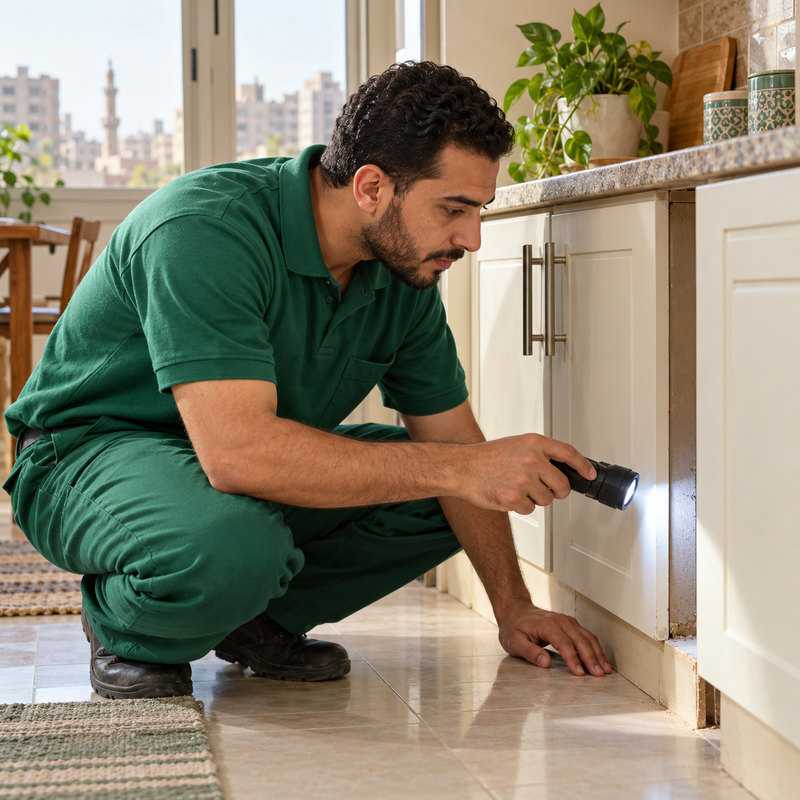
Mice are mostly active at night, so not seeing one doesn’t mean your home is clear. Take a strong flashlight behind the fridge, under the sink and into the bottom drawers. The U.S. Environmental Protection Agency (EPA) says droppings usually turn up next to food packages, in drawers and under the sink.
Then look at your bags. A bag of rice chewed open at a bottom corner is stronger evidence than a sound, which can come from a pipe or the neighbor upstairs.
| Sign | Where you’ll find it | What it usually means |
|---|---|---|
| Small dark droppings, like grains of rice | Next to bags, in drawers, under the sink | A mouse is eating close by |
| Gnaw marks about 2 mm wide | Bags, wood, wires | A house mouse |
| Gnaw marks about 4 mm wide | Wood, plastic, door edges | A rat |
| Dark greasy smears | Walls, pipes, beams | A fixed route it walks every night |
| Nest of shredded paper or cloth | Behind cartons, in a forgotten drawer | A nesting spot close to you |
| Musty smell from a closed space | Drop ceiling, behind the wardrobe | Hidden activity, possibly old or large |
| Chewed holes in the wall or floor | Low in the kitchen, around pipes | An entry point in use |
A lot of mice usually means the place gives them food and shelter together. With both, mice breed all year: a female can have 5 to 10 litters a year, 5 or 6 young in each, and the young mature in roughly 5 or 6 weeks. So the one mouse you saw in the kitchen deserves your attention today.
The U.S. Centers for Disease Control and Prevention (CDC) lists leptospirosis and salmonella among the diseases people can get from touching rodent droppings, urine or saliva, or from food those have contaminated. The list is general, not specific to Egypt, but it’s reason enough to keep bread out of open bags.
Mouse or rat: which one do you have?
The answer changes which trap you use. A house mouse may not even set off a rat trap, as the University of California points out. Look at the body: a young rat has a head and feet that look large for its size, and an adult mouse doesn’t.
| Feature | House mouse | Norway rat | Roof rat |
|---|---|---|---|
| Approximate weight | About 14 grams | 200 to 510 grams | 140 to 280 grams |
| Ears and nose | Large ears, small black eye | Ears don’t reach the eyes, blunt nose | Ears reach the eyes, pointed nose |
| Where it lives | Behind cartons, drawers, storerooms | Burrows beside foundations, basements, ground floors | Drop ceilings, wall cavities, wardrobes |
| Gnaw mark | About 2 mm | About 4 mm | About 4 mm |
| Smallest gap | About 6 mm | About 13 mm under a door | About 13 mm under a door |
I start with where the noise is. In the basement, in the stairwell storage (the small room many Egyptian buildings have under the stairs) or behind the ground-floor trash bin, it’s most likely a Norway rat. Above the drop ceiling on the fifth floor, a roof rat is the better guess. A house mouse rarely goes more than 9 meters from its nest or food, so you keep seeing it in the same kitchen.
How they get in: pipes, light wells, garage doors and roofs
A house mouse can get through an opening about 6 mm wide, roughly the width of a pencil. A rat, especially a young one, passes under a door with 13 mm of space beneath it, according to the University of California. A closed door proves nothing.
Pipes and the light well drain
In older buildings, a mouse often starts at the drain in the light well (the narrow air shaft that kitchens and bathrooms open onto) or at the hole cut around the pipe behind the sink. Look behind the washing machine too. A wide hole around a thin pipe is a ready-made road, and a greasy mark at its edge means it’s in use.
Garage door, basement and stairwell storage
A metal garage door often leaves a gap at the floor big enough for a rat. The University of California says Norway rats burrow beside foundations and under rubble, so check where the building’s foundation meets the ground.
A trash bin at the building entrance with no tight lid means a meal every night, two meters from the stairwell. Use a thick bin with a tight lid, and don’t leave bags outside your door overnight.
You can seal every gap in your apartment and the mouse will still move around the light well and stairwell, then come back through the first gap that opens. Ask the bawab (the building’s doorman) or the owners’ association for a bin lid and a metal mesh on the light well drain.
Roof and windows
Roof rats climb well. Check the vents and any window edge with no sealing strip, and trim branches so they stay about two meters from the roof. If you keep pigeons or chickens up there, store the feed in a thick container with a tight lid.
Why rat poison causes problems inside a home
The University of California’s Integrated Pest Management program says all rodent poisons are toxic to children, pets and wildlife. The U.S. National Pesticide Information Center adds that rodent baits are attractive to children and animals. Put those two statements next to an open plate under a stove, and you’ll see why I refuse this method in any home with a child.
The CDC recommends snap traps first and leaves poison or bait stations for infestations that continue. In the United States, consumer products are sold only in ready-made bait stations, and loose pellet baits aren’t allowed in them. The EPA has also limited the types that pose the highest risk to non-target animals to professional use. Searching for the “strongest poison” takes you in the wrong direction.
The mouse doesn’t die where you choose
Bait doesn’t kill a mouse on top of the plate. It eats, goes back to its nest, and usually dies inside the same building. The University of California warns plainly about what follows: odor and sanitation problems.
Picture that smell coming from above a gypsum ceiling you can’t open. With a trap, you see the mouse and pick it up with a gloved hand.
Cats and dogs pay the price
The EPA warns that pets and wildlife can be poisoned by eating rodents that have taken certain poisons, and it asks people to dispose of the carcasses quickly. The University of California notes that dogs account for the most deaths among pets. A cat roaming between the light well and the roof can find a staggering mouse before you do.
If bait has to be used, how?
If the infestation is large and traps haven’t been enough, bait should go only inside a tamper-resistant station, in a place children and animals can’t reach, following the label. The EPA advises against storing pesticides near any food, cat food included, and says to keep them in a locked cabinet. It’s better to have a professional handle this, and you should never mix poison into food yourself.
If poison was already put out
Maybe someone put a plate under the sink months ago and everyone forgot. Remove it now, wearing gloves. Put the material back in its original container or a sealed bag, keep it in a locked cabinet away from any food, and ask a qualified authority how to dispose of it. Don’t throw it into an open bin at the building door, where street cats can reach it.
If a child or pet touches the poison
Get medical help right away, even if the child seems completely normal. The medical encyclopedia MedlinePlus says plainly that you should not wait for symptoms if you suspect poisoning. Don’t try to judge the danger yourself, and don’t ask in Facebook groups.
- Move the container away from the child, and gently remove anything you can see in the child’s mouth with a clean tissue.
- Don’t make the child vomit unless a doctor or a poison center tells you to.
- Don’t give lemon, vinegar or any home antidote, and ask the doctor before you give any drink.
- Don’t put anything in the mouth of an unconscious child.
- Call an ambulance on 123 immediately if the child collapses, has a seizure, has trouble breathing, or you can’t wake the child.
- In any other case, go straight to the nearest hospital with an emergency room or a poison center, and take the original container with you.
The container matters because the medical team needs to know what the substance is. If the poison came in an unlabeled bag from the grocer, bring the bag as it is and tell the doctor that.
If the poison gets on the skin, take off the contaminated clothing and wash the skin under running water for at least 15 minutes, then call a doctor. If it gets in the eye, take out any contact lenses and rinse the eye with plenty of room-temperature water for 15 to 20 minutes, then get medical help.
For a cat or a dog, call the vet immediately, even if the amount was small, and don’t wait for signs. Take the container with you, say what time the animal ate it, how much the animal weighs and how much is missing from the container, and don’t make it vomit unless the vet tells you to.
If you are reading this because your thoughts have been heavy on you these days, and not because of a mouse, talk to someone you trust, or call the Ministry of Health’s mental health hotline on 16328. You matter.
Traps: which kind, and where
The way to get rid of mice that I recommend to any family starts with the classic snap trap, which the CDC recommends specifically. The University of California calls it the safest, most effective and most economical option for rats, so the order is the same if you’re working out how to get rid of rats. The CDC doesn’t recommend glue or live traps, because they can frighten the rodent into urinating, which raises the risk of infection.
Bait and placement
Put a pea-sized amount of peanut butter on the trap, or mutton fat if anyone at home has a peanut allergy. Set the trap in a T shape against the wall, baited end touching it, because mice walk along walls.
- Behind the stove and fridge, where a child’s hand doesn’t easily reach.
- Deep inside wardrobes and drawers where you found droppings.
- In the basement and the storage under the stairs, along the greasy smears.
- On top of pipes and shelves if you have a roof rat, with the trap firmly fastened.
For house mice, keep about 3 meters between traps. For rats, space them 3 to 6 meters apart. A badly infested home may need twelve traps or more.
If you have kids at home
Put traps inside boxes or in closed spots small hands can’t reach, because a snap trap hurts fingers. Set them after the children go to sleep, and check them in the morning before they wake up.
Teach your child not to touch a trap or a dead mouse, even if it looks like a toy, and ask about poison before you visit grandma’s house.
Check the traps every day and remove any dead mouse. The CDC advises keeping baited traps out for at least 15 days when you’re doing the work at home. If a week goes by with no catches and no new signs, the activity has most likely ended.
Sealing gaps: the step that keeps mice from coming back
Traps deal with what’s already inside, and sealing keeps the next ones out. The CDC and the University of California both say to seal every gap wider than about 6 mm, indoors and outdoors.
- Small gaps: stuff them with metal scouring wire, then fix it with a sealant. Wire alone rusts.
- Larger gaps: use metal mesh, sheet metal or cement, cut to fit tightly around the pipe.
- Vents: galvanized mesh with 13 mm openings. Lightweight chicken wire won’t do.
- Door edges: a metal strip if they show gnaw marks.
Don’t rely on foam, rubber, plastic or wood alone, since rodents chew through them. Start under the sinks, behind appliances and where the floor meets the wall.
Keep rice, pasta and flour in thick containers with tight lids, and take up the cat’s food at night.
| Feature | Snap trap | Open poison or plate | Bait in a locked station | Sealing gaps |
|---|---|---|---|---|
| With children | Safe if placed in a closed spot | Dangerous and unacceptable | Lower risk if tamper-resistant | Safe |
| With cats and dogs | Needs a spot they can’t reach | Direct and secondary danger | Risk from a poisoned mouse remains | Safe |
| Where the mouse dies | Inside the trap, where you see it | Usually inside the building | May be inside the building | Nothing dies |
| Stops mice coming back? | No | No | No | Yes, if done tightly |
| Suitable for | Any home | Not suitable for homes | Continuing infestation, handled by a professional | Every home |
Clean up after mice without exposing yourself
Don’t sweep up droppings or use a vacuum cleaner, because that can lift contaminated particles into the air, as the CDC warns. Follow this order:
- Open the room’s doors and windows for half an hour before you clean, and stay out of the room during that time.
- Put on rubber or plastic gloves.
- Spray the area with a household disinfectant, or with a freshly mixed solution of one and a half cups of household bleach in a gallon of water, about 3.8 liters. Let the area stay wet for 5 minutes.
- Wipe up with paper towels and put them in a covered bin.
- Wash your hands with the gloves still on, then take the gloves off and wash your hands with soap and water.
For a dead mouse or a nest, spray it with disinfectant first, tie it in a bag, tie that bag inside a second bag, and throw it in a covered bin. Never touch it with a bare hand.
Restaurants and warehouses: a different calculation
A mouse in a restaurant or food warehouse means spoiled stock and a customer who may see a tail under the table. Mice control here follows the same principle, with finer details.
The spot shop owners neglect most, in my experience, is the storeroom under the stairs. Leave a space between the stock and the wall and lift it off the floor, and store any pest control material away from food. In a place that serves food, I see mechanical traps and locked bait stations, handled by a professional, as the right choice.
Home remedies that don’t work
Mint, bleach and electric repellers are cheap and easy, and they delay the real fix by another week.
Mint and essential oils: the University of California says no repellent has solved a rat problem for more than a very short time.
Bleach in the corners: it belongs in disinfecting after you clean. It won’t close the opening the mouse uses.
Ultrasonic devices: their waves don’t pass behind furniture, and rodents get used to repeated sounds.
Getting a cat: a cat may catch some mice, but that’s rarely enough, and mice hide better around a cat.
Releasing the mouse far away: it can return if you haven’t sealed the way in.
When to call for help
Try traps and sealing yourself if the activity is in one clear spot. If it has reached places you can’t open or clean, such as central air conditioning ducts and closed gypsum ceilings, bring in a professional, which is the CDC’s own advice. And if you have a baby, an elderly person or someone sick at home, don’t put down poison yourself.
How we handle rodents on the job
Safety Service’s rodent control method starts by locating the entry points and the routes rodents take inside. After that come locked bait stations that children and pets can’t open, glue and mechanical traps in sensitive spots like the kitchen, and written recommendations for closing the gaps. In older buildings, we close the light well drain or the pipe opening behind the sink with special wire before we leave.
The company delivers its rodent service under its own method in one visit, with no need for you to leave your home and with a 5-year written warranty, and it is licensed by the Ministry of Health. Before the technician starts, tell him if you have a small child or a cat. With any company in this field, you have the right to ask to see its license, as the EPA advises.
Frequently asked questions
What are the signs of mice in a home?
The clearest signs are small dark droppings near food or under the sink, and gnaw marks on bags and wood. A gnaw mark about 2 mm wide points to a house mouse, and one about 4 mm wide points to a rat.
Is rat poison dangerous for children?
Yes, all rodent poisons are toxic to children and pets, and bait is made to be appealing to eat. A crawling child reaches the space under the stove first, so an open plate of poison is never acceptable. The U.S. Centers for Disease Control and Prevention advises starting with snap traps.
My child ate or touched rat poison. What should I do?
Get medical help immediately, even if your child seems normal, and don't wait for symptoms. Don't make your child vomit unless a doctor tells you to, and take the container with you to the nearest hospital with an emergency room or a poison center. If your child loses consciousness, has a seizure or has trouble breathing, call an ambulance on 123.
I touched rat poison with my hand. What should I do?
Wash your hand right away under running water for at least 15 minutes, with mild soap, and take off any clothing the poison got on. After washing, call a doctor or go to a hospital emergency room and bring the product container. If you touched your face or mouth, or if the poison was on a child's hand, don't put off going to the emergency room.
Can a cat be poisoned by eating a poisoned mouse?
Yes, a pet can be poisoned by eating a mouse that has taken poison, which is called secondary poisoning. Call the vet immediately even if the cat seems fine, bring the poison container if you have it, and don't make the cat vomit unless the vet tells you to. Pick up any dead mouse with gloves as soon as you see it.
How do I get rid of mice in a home with children?
The best method is snap traps in closed spots a child can't reach, along with sealing every gap wider than 6 mm with metal or cement. Check the traps every day. If a professional uses bait, it must be inside a tamper-resistant station.
Do mint or ultrasonic devices drive mice out of a home?
There is no reliable evidence that they drive out a mouse that has settled in a home. The University of California's pest management program says no repellent has solved a rat problem for more than a very short time. Getting mice out of a home starts with sealing the gaps.
What is the strongest rat poison?
There is no safe answer to this question, so we don't name types or places to buy them. More toxic means more danger to your child and your cat before the mouse, and the U.S. Environmental Protection Agency has restricted some types to professionals. Start with traps and sealing gaps, and leave any bait to a professional who puts it in a locked station.
Sources
- How to Trap Up to Remove Rodents (U.S. Centers for Disease Control and Prevention)
- How to Seal Up to Prevent Rodents (U.S. Centers for Disease Control and Prevention)
- How to Clean Up After Rodents (U.S. Centers for Disease Control and Prevention)
- Controlling Wild Rodent Infestations (U.S. Centers for Disease Control and Prevention)
- Restrictions on Rodenticide Products (U.S. Environmental Protection Agency)
- Safely Use Rodent Bait Products (U.S. Environmental Protection Agency)
- Identify and Prevent Rodent Infestations (U.S. Environmental Protection Agency)
- Options for Dealing With Rodent Infestations (U.S. Environmental Protection Agency)
- Tips for Hiring a Rodent Control Professional (U.S. Environmental Protection Agency)
- House Mouse, Pest Notes (University of California Statewide IPM Program)
- Rats, Pest Notes (Publication 74106) (University of California Statewide IPM Program)
- Rodenticides (National Pesticide Information Center)
- Poisoning First Aid (MedlinePlus, U.S. National Library of Medicine)
- First Aid: Act Fast! (Poison Control, National Capital Poison Center)
- Mouse and Rat Poisons: Anticoagulant Rodenticides (Poison Control, National Capital Poison Center)
- What to Do If Your Dog or Cat Has Eaten Rat Poison (Preventive Vet)
- Egypt prioritizes mental health support, expands services nationwide (Egypt Independent)
- Suicide Hotlines and Crisis Lines in Egypt (TherapyRoute)